

Lead follow-up automation
Almost nobody buys on the first message. Almost nobody follows up more than once. That gap is the cheapest revenue in your business.
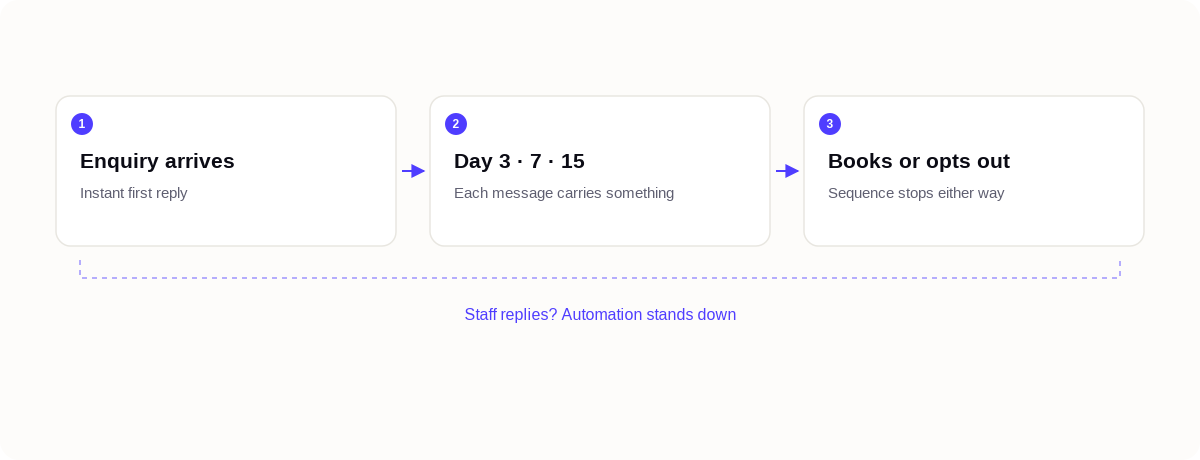
Lead follow-up automation sends a planned sequence of WhatsApp messages to every enquiry that did not convert — typically on day 3, day 7 and day 15 — and keeps going until the person books or opts out. Each message is written to be worth receiving rather than a reminder that you exist, and every reply is synced to your CRM or sheet so your team sees the full thread.
- Typical cadence
- Day 3 · 7 · 15
- Runs until
- Booked or opted out
- Syncs to
- Zoho, HubSpot, Sheets
- Cost
- Quoted with your setup
Why follow-up dies in practice
Nobody decides to stop following up. It just loses to whatever is urgent. A lead from eleven days ago has no one chasing it, no deadline attached to it, and no place in anybody's morning. So it sits.
The fix is not discipline or a better CRM reminder. It is taking the task off people entirely.
What the sequence actually says
A follow-up that says 'just checking in' teaches people to ignore you. Each touch in the sequences we write carries something: the answer to the objection that usually comes next, a slot that is actually open, a piece of proof, a straightforward question that is easy to answer with one word.
The last message in every sequence is an honest close — a clear offer to stop. Opt-outs are cheap. Being the business that never stops messaging is not.
- Sequences written per enquiry type, because a price enquiry and a site-visit enquiry need different messages.
- Automatic stop the instant somebody books, replies meaningfully or opts out.
- Every message and reply written back to your CRM or sheet, so nothing lives only inside WhatsApp.
- Re-engagement for old, cold lists — run once, carefully, with a clear opt-out.
Speed matters more than sequence
For high-intent leads — a portal enquiry on a property, a form fill on a treatment — the first reply matters more than all the follow-ups combined. Whoever answers in the first few minutes usually wins. We wire instant response first, and the sequence behind it.
Questions people ask
How many follow-ups is too many?
Three to five well-spaced, genuinely useful messages is the range that works for most Indian local businesses, with a clear opt-out in the last one.
The exact number matters less than whether each message carries something worth reading. We tune the cadence against your own reply data after the first month.
Does it sync with my CRM?
Yes — Zoho, HubSpot, most common CRMs, or a plain Google Sheet if that is what you run. Messages and replies are written back so your team sees the whole thread.
Can I stop the sequence for a specific customer?
Yes. Any staff reply stops the automation for that conversation immediately, and customers can opt out themselves at any point.